
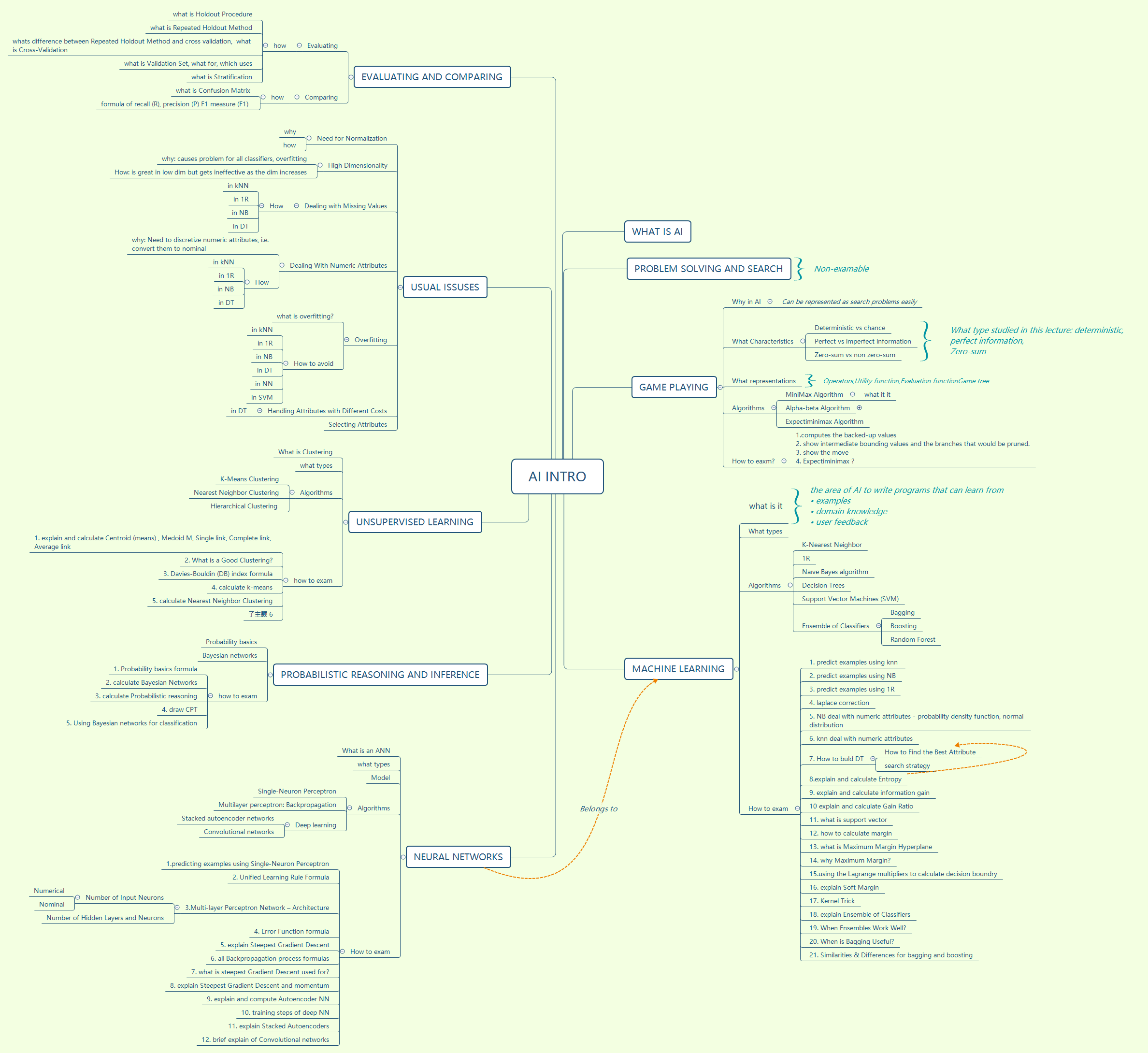
AI Introduction
What is AI
Problem solving and search
Game playing
Why in AI
- Can be represented as search problems easily
What Characteristics
- Deterministic VS chance
- Perfect VS imperfect information
- Zero-sum VS non zero-sum
What types studied in this lecture:
- Deterministic,
- Perfect information,
- Zero-sum
Algorithms
- MiniMax Algorithm
- what it it
- Alpha-beta Algorithm
- Expectiminimax Algorithm
How to eaxm?
- computes the backed-up values
- show intermediate bounding values and the branches that would be pruned.
- show the move
- Expectiminimax ? Operators,Utility function,Evaluation functionGame tree (What representations)
Machine learning
what is it
what types
Algorithms
- K-Nearest Neighbor
- 1R
- Naïve Bayes algorithm
- Decision Trees
- Support Vector Machines (SVM)
- Ensemble of Classifiers
- Bagging
- Boosting
- Random Forest
How to exam
-
predict examples using knn
-
predict examples using NB
-
predict examples using 1R
-
laplace correction
-
NB deal with numeric attributes - probability density function, normal distribution
-
knn deal with numeric attributes
-
How to buld DT
- How to Find the Best Attribute
-
explain and calculate Entropy
-
explain and calculate information gain
-
explain and calculate Gain Ratio
-
what is support vector
-
how to calculate margin
-
what is Maximum Margin Hyperplane
-
why Maximum Margin?
-
using the Lagrange multipliers to calculate decision boundry
-
explain Soft Margin
-
Kernel Trick
-
explain Ensemble of Classifiers
-
When Ensembles Work Well?
-
When is Bagging Useful?
-
Similarities & Differences for bagging and boosting
The area of AI to write programs that can learn from
• examples • domain knowledge • user feedback (what is it)
Neural networks
What is an ANN
What types
Model
Algorithms
- Single-Neuron Perceptron
- Multilayer perceptron: Backpropagation
- Deep learning
- Stacked autoencoder networks
- Convolutional networks
How to exam
- predicting examples using Single-Neuron Perceptron
- Unified Learning Rule Formula
- Multi-layer Perceptron Network – Architecture
- Number of Input Neurons
- Numerical
- Nominal
- Number of Hidden Layers and Neurons
- Error Function formula
- explain Steepest Gradient Descent
- all Backpropagation process formulas
- what is steepest Gradient Descent used for?
- explain Steepest Gradient Descent and momentum
- explain and compute Autoencoder NN
- training steps of deep NN
- explain Stacked Autoencoders
- brief explain of Convolutional networks
Probabilistic reasoning and inference
Probability basics
Bayesian networks
how to exam
-
Probability basics formula
-
calculate Bayesian Networks
-
calculate Probabilistic reasoning
-
draw CPT
-
Using Bayesian networks for classification
Unsupervised learning
What is Clustering
what types
Algorithms
- K-Means Clustering
- Nearest Neighbor Clustering
- Hierarchical Clustering
How to exam
- explain and calculate Centroid (means) , Medoid M, Single link, Complete link, Average link
- What is a Good Clustering?
- Davies-Bouldin (DB) index formula
- calculate k-means
- calculate Nearest Neighbor Clustering
Usual issuses
Need for Normalization
- why
- how
High Dimensionality
- why: causes problem for all classifiers, overfitting
- How: is great in low dim but gets ineffective as the dim increases
Dealing with Missing Values
- How
- in kNN
- in 1R
- in NB
- in DT
Dealing With Numeric Attributes
- why: Need to discretize numeric attributes, i.e. convert them to nominal
- how
- in kNN
- in 1R
- in NB
- in DT
Overfitting
- what is overfitting?
- how to avoid
- in kNN
- in 1R
- in NB
- in DT
- in NN
- in SVM
Handling Attributes with Different Costs
- In DT
- Selecting Attributes
Evaluating and Comparing
Evaluating
- how
what is Holdout Procedure
what is Repeated Holdout Method
whats difference between Repeated Holdout Method and cross validation,
what is Cross-Validation
what is Validation Set, what for, which uses
what is Stratification
Comparing
- how